Ask the Quexperts: How does multipath affect GNSS accuracy?

GNSS positioning relies on measuring the travel time of signals from satellites to the receiver. These measurements are used to compute the pseudorange, which is used to estimate the distance between the satellite and the receiver.
In open-sky conditions, positioning accuracy of 2-5 meters can be obtained. However, in dense urban environments or near reflective surfaces, positioning accuracy can degrade significantly due to multipath.
Multipath occurs when GNSS signals reach the receiver through multiple propagation paths instead of a direct line-of-sight (LOS) path. Reflections from surrounding objects arrive later at the antenna and therefore are interpreted as having a longer propagation distance, translating into ranging errors and reducing positioning accuracy.
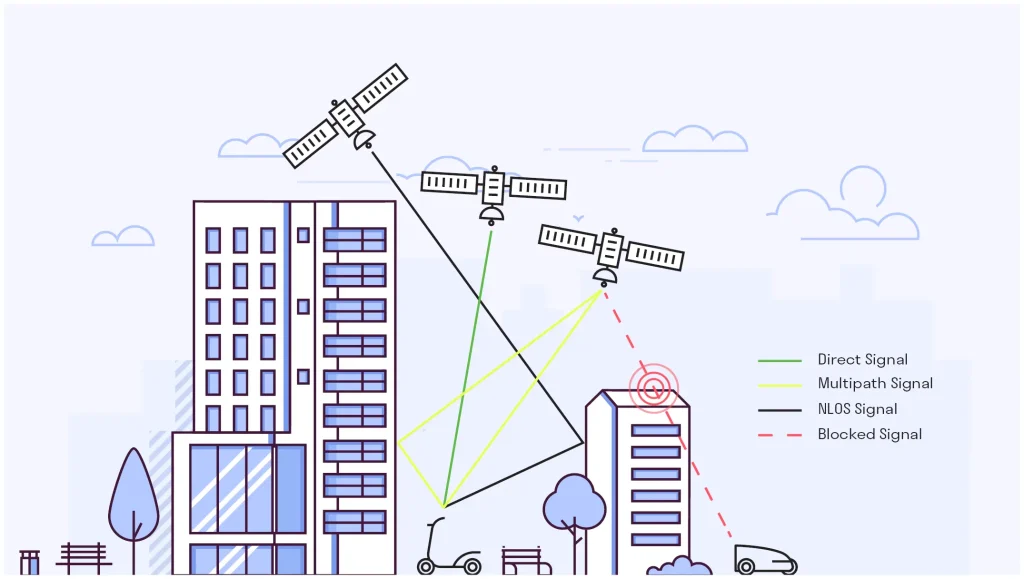
In more challenging environments, the direct line-of-sight (LOS ) may even be unable to reach the receiver, resulting in a situation known as non-line-of-sight (NLOS). In this scenario, the receiver relies mainly on reflected signals, resulting in much larger positioning errors.
Common reflective surfaces include buildings, glass facades, metal structures, vehicles, water surfaces, and even the ground.
How does multipath affect GNSS performance?
Multipath primarily affects GNSS performance by creating errors in pseudorange measurements. These include:
- Increased horizontal positioning errors
- Delay or prevention of a real-time kinematic (RTK) correction fixed solution
- Reduced positioning availability in challenging environments
How can multipath be mitigated?
Modern GNSS receivers typically combine several techniques to minimise multipath rather than relying on a single solution.
- Multi-constellation: Tracking more satellite constellations increases the probability of maintaining line-of-sight signals.
- Multi-band GNSS: Multi-band GNSS receivers can better compensate for ionospheric errors while improving robustness in challenging environments, making them more robust than traditional single-band receivers
A logical solution is to track more satellite constellations, thereby increasing the number of satellites within direct line of sight. This increases the availability of LOS signals and can counter multipath issues. However, this can be a costly way to address the problem.
The GNSS multipath error can also be minimised by improving the antenna quality, for example by selecting an antenna that is able to mitigate the effects of the signal coming from certain low elevation directions. Proper siting of the antenna, such as moving it away from reflecting objects or areas of high interference, when possible, can also help to mitigate multipath issues.

