Ask the Quexperts: RTK service or local base station — which approach should you choose?

Real-time kinematic (RTK) correction is a reliable, mature solution that delivers instant centimeter-level positioning accuracy for GNSS applications. By leveraging carrier-phase measurements and corrections from reference stations, RTK enables a rover receiver to achieve centimeter-level precision within seconds. However, not all RTK architectures deliver the same level of performance. Today, two main approaches are widely used: RTK service (network RTK) and local base station (local-base RTK).
RTK service: wide coverage and scalability
RTK service solutions rely on continuously operating reference station (CORS) networks, where correction data is generated from a dense infrastructure of reference stations and delivered via IP connectivity using network transport of RTCM via internet protocol (NTRIP). In this model, corrections are computed by interpolating ionospheric and tropospheric error models across multiple stations. Thereby enabling wide-area coverage through commercial RTK service providers.
This approach makes RTK services highly scalable and easy to deploy, particularly for distributed fleets or applications spanning large geographic areas with no fixed operational center. RTK services and single, local base station solutions are both good choices for achieving precise location information.
RTK performance also depends on low-latency, continuous correction delivery. Temporary disconnections for half a minute or a minute will force the receiver back to a float solution. Thereby degrading accuracy from centimeters to decimeters or even meter level until re-convergence. RTK service providers do not always support all frequency bands. Many still operate only on L1/L2 bands, without full support for newer signals such as L5. As a result, compatibility between GNSS hardware and correction services is not always guaranteed.
RTK services and single, local base station RTK solutions are both good choices for achieving precise location information. The relative merits of each are explained next.
Relevant resources


Local base station: performance through proximity
The closer the base and rover are, the stronger the correlation between their measurements. As the distance increases, this correlation degrades, especially under rapidly changing ionospheric conditions.
Both local base RTK and network RTK are affected by ionospheric variations. However, a local base setup — particularly within short distances such as up to 5km — is less sensitive to these changes and offers higher reliability.
This makes local base RTK well-suited for applications such as robotic lawnmowers, precision farming or large private sites, where a base station can be installed on-site.
Additionally, local base systems can operate without cellular connectivity by using alternative communication links such as radio, LoRa or Zigbee.
The base station position must be accurate, as any error creates a fixed offset in rover positioning. However, this depends on the use case:
- Absolute positioning requires precise global coordinates, such as in surveying and mapping use cases.
- Relative positioning only tracks movement precisely within a local area, such as for lawnmowers, precision farming, making it less sensitive to base errors.
This model requires deploying and operating your own infrastructure, including installation, power supply, connectivity, and correction delivery via an NTRIP caster or cloud-based service. Beyond 25 to 30km, baseline-dependent atmospheric errors grow and positioning performance begins to degrade, reinforcing proximity as the defining constraint of this architecture.
Related products
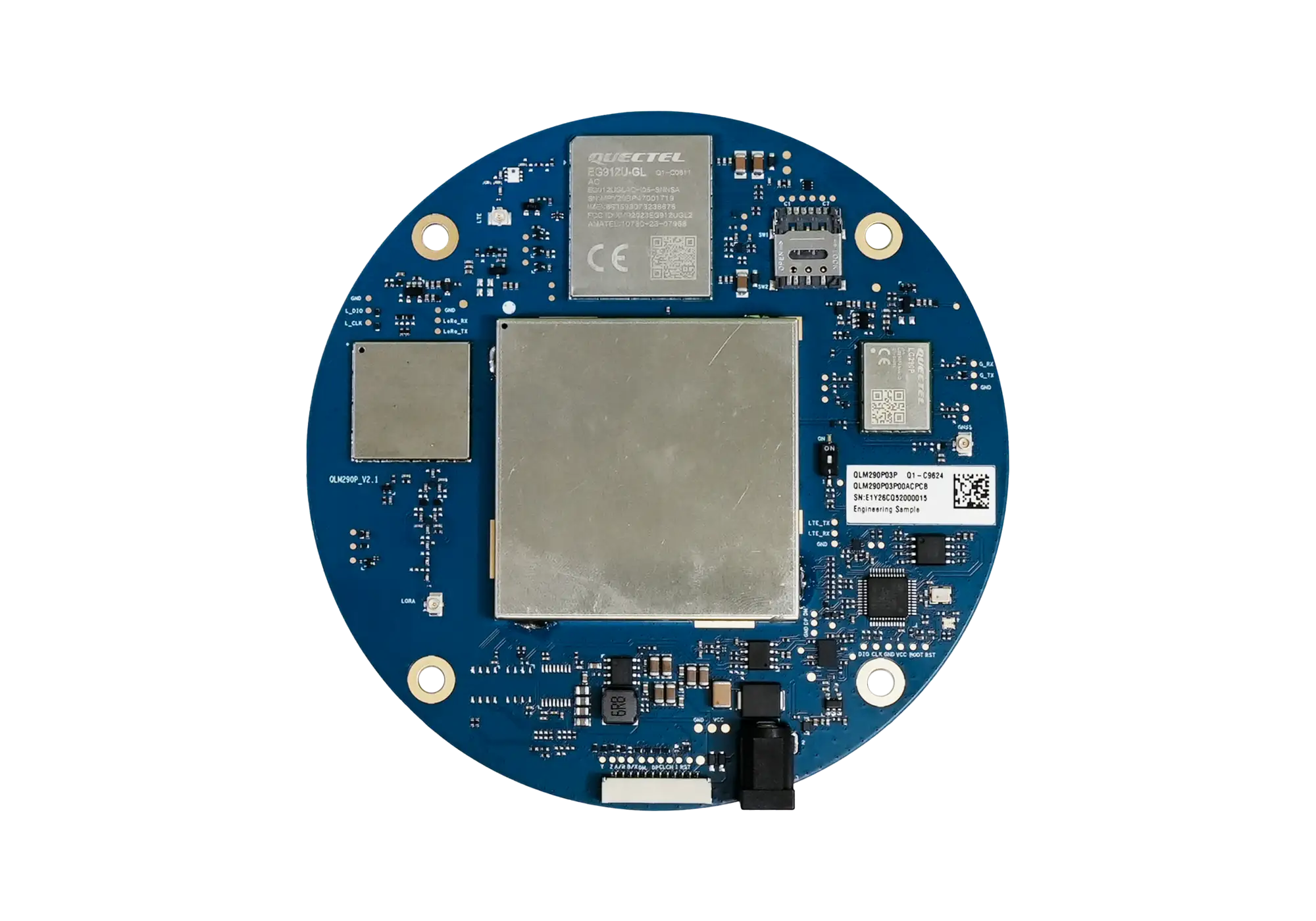
QLM290P (03) smart antenna device with RTK, LoRa, and LTE


A balanced view of RTK service and local base station architectures
Both RTK service (network RTK) and local base RTK deliver centimeter-level accuracy, but with different trade-offs. RTK services offer wide-area coverage and scalability through CORS infrastructure, with reliance on connectivity and modeled corrections. Local base RTK, by contrast, maximizes accuracy and fix reliability through proximity, at the cost of on-site infrastructure and limited coverage.
| Aspect | Network RTK Service (NRTK / CORS) | Local base station |
| Infrastructure | Dense CORS Network operated by service provider. No infrastructure deployment | Single GNSS base station, power and communication installed by the user |
| Coverage/baseline | Depend on the service provider, normally national or continental. | User can deploy base very close to rover; baseline often <25km |
| Communication | Corrections via NTRIP over cellular/internet | Radio/LoRa/Zigbee/local UP/cellular; can operate without internet |
| GNSS Signal Support | Depends on CORS receivers and RTCM streams; some networks may not yet support L5/E5/B2a signals | Support all signals tracked by the base receiver |
| Operation cost | Subscription fee + cellular data | Hardware cost with minimal recurring fees |
| Error sensitivity | Network modelling reduces atmospheric errors | Short baseline significantly reduces ionospheric and atmospheric errors |
| Suitable applications | Surveying, mapping, robotics across large geographic regions | Precision agriculture, construction sites, mining, local robotics |
The right choice depends on your priorities:
- For scalability and ease of deployment choose an RTK service
- For general correction availability and performance robustness select local base RTK (if the infrastructure is feasible)

